Grappling with the conflicts and contradictions that may lie ahead

Introduction
In this edition of Benefits Barometer, we have consistently advocated for shifting the focus for driving policy decisions away from strictly GDP-growth-based metrics towards a more holistic, well-being-based approach that may result in slightly different priorities. Drawing on the work of University of Pretoria economist Prof Lorenzo Fioramonti, we contend that growth is more than the mere sum of transactions on which GDP measures are based. In this chapter, we address some of the hard decisions and trade-offs that may lie ahead.
The case for a well-being economy
During a presentation to a Gordon Institute of Business Science (GIBS) forum, University of Pretoria economist Prof Lorenzo Fioramonti, author of Wellbeing Economy: Success in a World Without Growth, put the case for a well-being economy into perspective when he critiqued the notion of ‘growth at all costs’. Instead, he advocated the pursuit of economic growth that puts the well-being of all at its centre.1
In his book, Fioramonti defines the well-being economy as an ecosystem that virtuously puts people and nature first. He argues that breaking free from the growth preoccupation can help build an economy in which the multipliers have an impact where the need is greatest.2 Fioramonti asserts that the well-being of a society is a result of two main drivers: strong ecosystems and social capital. A successful economy is one that prioritises development within natural and social systems.3
We all need to provide shelter, food, water and protection for ourselves and our families. Although these objectives are universal, individuals and households have different circumstances and priorities, which affect how they go about meeting these objectives.
In a country like South Africa where poverty and inequality are deeply ingrained in the structure of the economy, you’d expect greater emphasis on development objectives that prioritise economic multipliers and social security interventions. Yet, South Africa has done the exact opposite by adopting a misconceived and myopic approach to economic growth. As Fioramonti argues, we need to challenge the belief that South Africa needs 5% or 6% GDP growth in order to address its challenges.4
One consequence is an economy that relies on the compulsory savings of the employed to meet social protection challenges. In round numbers, South Africa pays grants to around 17 million recipients.
By contrast, between 6 and 7 million income tax payers are expected to submit returns from the 16,3 million employed. These numbers ignore consumption taxes on individuals by way of VAT and taxes on property, capital gains and levies on fuel to name but a few examples.
In other words, the progressive tax system aims to redistribute income to poorer households, largely through the fiscus and government spending. This model is simply unsustainable, not least because the South African tax base is narrow and the capacity of taxpayers to continue funding expansions in social security is questionable.
At a macro level, the country’s immense unemployment has created two separate economies – one for those included in the mainstream economy and one for those who are marginalised from it. The future of economic development depends on decentralised economic empowerment that moves the focus away from a system dominated by a few big companies or state enterprises towards a system of production led by many small businesses. Fioramonti uses the example of Eskom as a large, dominant business following an obsolete economic model that limits the country’s potential. The system was designed to ensure the country remained dependent on Eskom instead of empowering small businesses and households to become the drivers of a new economic era through independent power production.5
We need a new conversation about real economic transformation that prioritises overcoming the challenges of widening inequality and the growing discontent we see every single day. ‘It is not normal that we face these types of challenges,’ Fioramonti says. ‘We have a moral duty to take a step back and realise these things shouldn’t happen. We shouldn’t have so many people in poverty, so much inequality; we shouldn’t have this huge divide.’6
Fioramonti concludes that the standardisation of economic development models is problematic. The role of the state in a well-being economy, he says, is to create enabling conditions for the co-production of services whenever possible. The well-being economy does just that: it allows and empowers people to choose their own ways to solve their unique issues.
African solutions for African problems? Perhaps. But first, let’s evaluate some of the complexities we need to consider in trying to address the challenges set out in this year’s Benefits Barometer.
The nature of the problem
The National Development Plan has identified inequality, poverty and unemployment as major challenges. In the context of social protection and social mobility, we add diversity to the mix as a fourth challenge. We examine each of these challenges, starting with diversity, as key development priorities.
Diversity
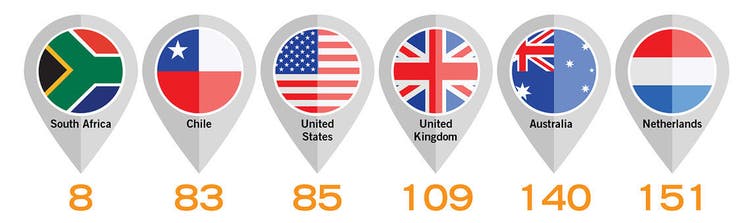
Studies in the area of ethnic and cultural diversity use a metric to measure ethnic fractionalisation: ‘the probability that two randomly selected individuals from a country will be from different ethnic groups’.7 Using this metric, one study found that 17 of the 20 most diverse countries in the world are African (South Africa ranks eighth on this list based on Fearon’s 2003 study).8
To put this in perspective, here are the rankings of countries often cited as examples of having the types of social benefits (both public and private) that are needed for South Africa:
In the South African context, government-imposed social security schemes such as the planned National Health Insurance and recently mooted National Social Security Fund may not address the challenges of a diverse and unequal society. In fact, they tend to provide a sort of ‘lowest common denominator’ of benefits.
Each of South Africa’s diverse social groupings has a distinct culture that shapes and influences the way people think about their financial needs and the best ways to meet those needs. It is therefore unsurprising to find greatly different approaches to saving, investing and insurance in different groupings.
Inequality
South Africa has the second-highest Gini coefficient in the world (0.625).9 But Southern Africa in general appears to have a problem in terms of income inequality: among the six countries with the highest Gini coefficient are Lesotho (first), Botswana (fifth) and Namibia (sixth).
The Gini index measures the degree of inequality in the distribution of family income in a country. A high coefficient implies that both the financial means and needs of people are going to be vastly different across the country.
This data has two important implications:
- A one-size-fits-all solution to social protection and social mobility is unlikely to be anywhere near optimal.
- 2. A public system that only provides at the most basic level is unlikely to be of value to the middle-to-higher-income earners who will be looked at to fund the systems.
These are important hypotheses in arriving at our suggestions for a way forward.
Poverty
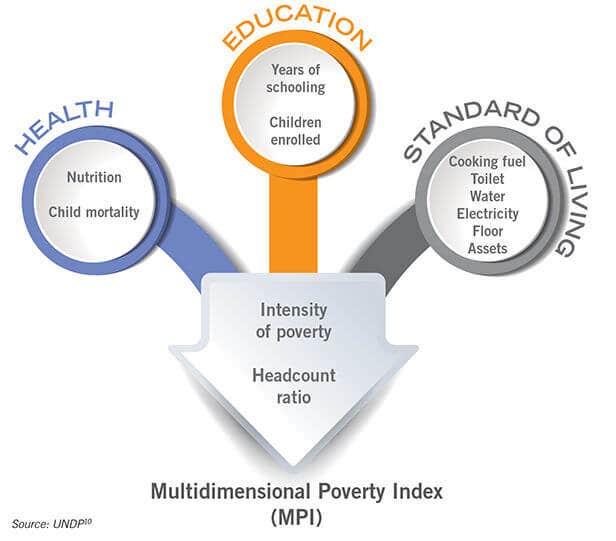
The Multidimensional Poverty Index (MPI), of the United Nations Development Programme (UNDP), complements monetary measures of poverty. As shown in Figure 5.1.1, it considers overlapping deprivations across the same three dimensions as the Human Development Index (health, education and standard of living).
It shows the number of people who are multidimensionally poor (suffering deprivations in 33% or more of the weighted indicators) and the number of weighted deprivations poor households typically contend with.
The index can be deconstructed by region, ethnicity and other groupings as well as by dimension and indicator, making it a useful tool for policymakers. By using the index, they can target groupings where poverty measures are the worst in order to allocate resources efficiently. The index can also be used to monitor the impact of policy intervention.
The index covers about 1.5 billion people in 102 developing countries. About 29% of them live in multidimensional poverty – that is, with at least 33% of the indicators reflecting acute deprivation in health, education and living standards. And close to 900 million people are at risk of falling into poverty if setbacks occur – financial, natural or otherwise.
South Africa ranks 42nd out of the 102 developing countries. Less than 2% of the population experiences severe multidimensional poverty, but nearly 20% is close to multidimensional poverty. The dimension of health contributes around 60% of South Africa’s score.
Figure 5.1.1: United Nations Development Programme (UNDP): Multidimensional Poverty Index
Unemployment
South Africa’s official unemployment rate in the first quarter of 2018 was 26.7%.11 This figure excludes discouraged job seekers, which understates the true picture somewhat. Some authors have put the number as high as 50%.
Of the 10.3 million South Africans aged between 15 and 24, 32.4% (approximately 3.3 million) were not in employment, education or training in the first quarter of 2018, implying that close to one in three young South Africans were disengaged from the labour market.12
We also see that unemployment is spread unevenly throughout the various provinces, and between rural and urban areas.
So, what is required?
Each of these challenges shapes the way we look at the world and how we go about solving the problems that life throws our way. We have argued for a more holistic approach to the growth metrics that drive our policy choices. We also need to recognise that there is no one-size-fits-all approach.
A sensible way to deal with the incredible complexity of challenges and needs reflected in South Africa’s diverse population may be to provide solutions that are increasingly flexible, individualised and targeted at specific needs. These solutions may also be complex in design and operation.
Why individualised?
Individualisation is about modifying something – in this case, benefits – to suit the particular requirements of an individual person. Individualisation is a way of seeing each member of the fund or scheme as a separate client.
The evidence supporting a more personalised and customised financial journey that addresses what matters most to that individual is becoming overwhelming. Research suggests that as the workplace evolves towards being aligned with the needs of individuals, employees will look for more flexibility in work options, including benefit options. They will also want an increased focus on their well-being (physical, mental and financial).13
In fact, according to the same research, employees pay almost as much attention to their benefits as they do to their pay. Furthermore, as businesses ‘go global’, so do employees. As global citizens, employees will not be content with localised benefit structures. Their benchmark for measuring what they are offered (and what they offer) will increasingly be what is ‘best-in-class’ globally.14
As digital development allows us to reach more people in more personal ways, individuals will become the centres of information and the focal point of all strategies. The value proposition becomes employee-centric. We have seen retirement funds and employers respond by allowing choices for investment strategies, risk benefits and contribution levels. This flexibility should continue, and we expect to see a greater adoption of flexible benefit structures.
But the reality is that most people find finances scary. Furthermore, retirement is too elusive a concept for most to even think about. With the changing world of work, where the whole concept of retirement appears to be getting set aside or reframed, this apathy towards saving for tomorrow is likely to get worse.
The next revolution will be default strategies – not the one-size-fits-all defaults we’ve had in place for years but defaults which are the right size for each person and that require limited interaction from them. In previous editions of Benefits Barometer, we’ve also shown that customising benefits to some degree does a better job of meeting needs. We have specifically considered such smart defaults for:
- Risk benefits: We proposed a default lifecycle approach to providing risk benefits, with individual flexibility to increase or decrease cover, and showed that it is more effective in meeting actual needs.15
- Investment strategies: We proposed that individualised, goals-based investment strategies are more effective than typical lifestage or target-date fund strategies.16 Individualising the solution, making it dynamic and focusing on the goal can add significant value to the individual investor.17 Not following this approach requires investors to place sometimes large amounts of initial capital (a windfall) at risk, expecting to achieve the same utility of lifetime consumption with a static strategy that the alternative, dynamic strategy would yield with no initial capital.
- Financial well-being: We proposed that shifting the focus from meeting narrow goals to supporting financial well-being in a more holistic sense was required (and desired, based on our previous research). We also stated that financial well-being was a mixture of financial capability (knowledge, product choice, budgeting and planning) and achieving life satisfaction by dealing with what mattered most to people. For this reason, the definition is partly subjective and individualised.18
Individualising benefits certainly has an appeal. By that logic, the financial services industry could well go the route of providing the type of portable, individualised ‘financial aid schemes’ that are currently on offer with medical aid schemes, but to a wider segment of society than those who can afford medical schemes.
Why portable?
Achieving long-term goals requires long-term planning. Retirement is a hazy and distant concept to most people. It is also lower on the priority list and certainly less pressing than most of their immediate financial challenges, as evidenced by low preservation rates (fewer than 10% of retirement fund members preserve their benefits if they leave the fund before they retire).
National Treasury19 has identified portability as desirable and, through pension fund regulations, has tried to nudge people to preserve benefits, either in the existing fund or by transferring to their new fund, rather than cashing out and starting over.
Another reason to make the solution portable is the changing world of work – and the changing worker. This was a topic we dealt with in the 2017 edition of Benefits Barometer.
The Fourth Industrial Revolution was the topic at the World Economic Forum’s gathering in Davos in 2017. The inexorable rise of automation, machine learning, artificial intelligence and robotics has the following implications for the workplace – and jobs – of the future:
- fewer unskilled or repetitive jobs, as these will be done by machines
- reskilling of employees to do different jobs, especially jobs that integrate with technology
- increase in higher-end jobs (jobs higher up the value chain)
- decline of whole industries and creation of new ones
The rise of the free agent
As people work for themselves, on their own terms, the speed at which employees rotate from one job to the next, or in and out of employment, will increase. Jobs will be about the functions performed and not who they are performed for.
This is perhaps one of the scarier trends affecting retirement funds and their members. At the member level, individuals in defined contribution plans typically carry the financial planning risk associated with their finances. However, they have the guardrails introduced by forced savings into retirement and not being able to access these funds while still employed.
Introduce a world where employees are self-employed, contracting out to one or several employers at a time project by project, and the financial planning risk becomes more acute. They will face the same issues that the selfemployed face today – how to access risk pooling, cross-subsidisation and economies of scale that lead to lower costs – but there will be many more such cases.
Thus the financial planning problem reaches a whole new epic scale. Yes, they can still use various vehicles to save – retirement annuities, tax-free savings accounts, unit trusts and the like – but will they? And how much do they need to save? Where should they invest? At what fee? Where will the guidance come from?
These are the challenges the individual faces. And allowing the structures to be portable mean that this will reduce the number of times an individual may need to face these challenges.
Is an individualised and portable system the answer?
Before we commit to an answer, we need to consider the drawbacks of an individually focused benefits plan. We need to clearly understand what we would have to sacrifice (and therefore what trade-offs are needed) to create a transformed, cohesive society in an environment where benefits attach to the individual. There are at least four potential issues that need to be discussed:
- cross-subsidisation
- risk pooling
- behavioural biases
- competing priorities
Cross-subsidisation
Cross-subsidisation is pervasive in society:
- The rich subsidise the poor (directly, through providing capital and employment opportunities, and indirectly, through the progressive tax system).
- The working taxpayer subsidises the unemployed and the elderly (through the non-contributory Older Person’s Grant, for example).
- The healthy subsidise the sick.
- The young subsidise the old by paying higher premiums than are strictly needed.
And then there is the sharing of costs – many hands making light work of the expenses of group schemes – resulting in a lower overall cost for each person.
These cross-subsidies level the playing field to some degree and serve to include those on the ‘wrong’ side of the equation. Let’s consider a few examples:
1. Retirement savings
In a typical pension or provident fund sponsored by an employer, all employees are required to belong to the scheme. Lower-income employees are essentially cross-subsidised by higher-income employees – and the more employees there are, the lower the costs.
According to the Sanlam Benchmark Survey 2018, members of very large funds (more than 10 000 members) pay a lower administration fee (0.41% of payroll) compared with members of smaller funds (fewer than 500 members), who pay on average 0.77% of payroll.20 Expressed as a fixed fee per member, this varies from R33.92 a month for very large funds to R68.11 a month for smaller funds.
Another factor is the negotiating power of institutional buyers and the fact that fewer ‘transactions’ are required. For example, one payroll deduction for many employees rather than individual debit orders is cheaper and more efficient. The investment fees paid by pension funds are typically lower than the investment fees paid by individuals, as the acquisition, onboarding, servicing and other costs are more efficient in a group business.
Using the assumptions below, we see that a saving of 1% a year in investment fees can result in nearly 20%
more capital available in 30 years:
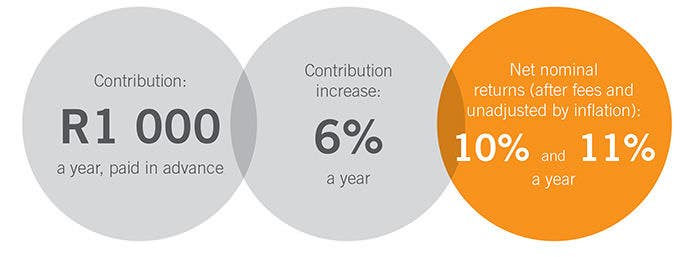
Put another way, with lower costs, you need less capital to reach a defined target, which frees up resources for meeting other needs.
These factors contribute to more bang for buck: for the same deduction, more savings find their way into the investment than if individuals were to go it alone.
Caution: This exercise must not be extrapolated ad infinitum, as the cost efficiencies are a reducing marginal return. Beyond some point, savings decrease with size as big datasets and structures start bringing their own inefficiencies into the process. One only needs to consider the inefficiencies of monopolies to see this effect in action.
2. Group life and disability income schemes
Besides having lower administrative costs, group schemes also remove the anti-selection risk that insurers face on underwritten benefits. This refers to the risk of someone insuring themselves when a claim is imminent – essentially, relying on others in the pool to pick up that cost. Insurers price for this anti-selection risk. In a group scheme, all employees are included in the insurance, effectively removing most of the anti-selection risk that the insurer may face. Group schemes therefore reduce this particular aspect of insurance pricing.
The other key benefit of cross-subsidisation (and related to anti-selection) is inclusion. Many people would, because of their health or other status, be uninsurable on their own and would therefore be declined cover. However, on the group scheme everyone (no matter how ill they are) is covered for the benefits, up to the limits set by the policy.
3. Medical schemes
Restricted medical schemes which are only available to a specifically defined group may be cheaper than open medical schemes, that anyone can join. Open medical schemes have marketing costs and higher anti-selection costs as a result of members who join only when they are sick and want to claim from the scheme.
The Council for Medical Schemes’ annual report for 2015/16 shows that restricted schemes have lower average contributions than open schemes, higher claims ratios (they spend more of your money on healthcare than on non-healthcare expenses) and lower administration costs.21
It’s clear, then, that employee benefits can often be much cheaper for you than taking out your own life and disability cover, funding your own retirement savings and, sometimes, joining an open medical scheme to cover your healthcare expenses.
Well-structured and appropriately priced employee benefits are good for employees and company profitability. Employees who are in control of their personal finances and debt are more loyal towards an employer that shows it is concerned about their financial well-being.
Cross-subsidisation overlaps to some degree with the concept of risk pooling, which we tackle next.
Risk pooling
The concept of risk pooling is the fundamental tenet of insurance. Let’s assume that you face the risk of your house burning down from an electrical fire. The probability of this happening is fairly low but not unheard of. If your house burns down, the odds are that you will not be able to rebuild it and replace all the contents from your income or savings. And you may still need to pay off the bond you took on the house without having the house as an asset. Such an event would be catastrophic and could wipe you out financially.
If you wanted to build up enough savings to protect yourself against some or all of this risk, you would need to put away vast sums of money – generally not possible if you are still trying to pay off the bond and live from day to day.
So, you get together with a few thousand people facing the same catastrophic but unlikely event, and you all contribute a little towards the pot, to be used if the catastrophe happens to one of you. This is the central concept and power of insurance: you pool your risk with that of others and by doing so, you fund only the portion of the risk you are exposed to.
Insurance is one of the key financial products that prevents people slipping down the social ladder. It allows you to protect the lifestyle you have managed to build and take risks that would otherwise be unwise.
Behavioural biases
We have written extensively about behavioural biases in previous editions of Benefits Barometer. We won’t repeat all that here (you can read the 2014 and 2015 editions for the detail) but will point out that people exhibit a range of behaviours that could destroy value, including:
- myopia: near-term priorities outweigh more important, longer-term priorities
- apathy: people do not take an active interest in planning for the future
- choice aversion: faced with an array of options, people may choose to do nothing – when it comes to saving, investment and insurance, this could be catastrophic
Competing priorities
Often, the low preservation rate of retirement savings is blamed on greed and low financial literacy. However, the more likely reason is that people are heavily indebted (South Africa has a 73% debt-to-income ratio on average) and struggling to make ends meet. Their priorities are likely to be housing, education and transportation rather than long-term saving.
Then there are the demands of being the only regular breadwinner in an extended family and the expectation that it’s your duty to see to the housing and education needs of the family. This is commonly referred to as ‘black tax’, but it is not constrained only to black South Africans.
All of these factors play a role. With such priorities, it is little wonder that just one in ten people who leaves a retirement fund before retirement chooses to preserve their benefits. And this leakage is the single biggest contributing factor to lower-thanrequired outcomes at retirement. It is not that costs are too high, contributions too low and investment returns poor. On the contrary, investment returns have generally been good, costs are coming down and contribution rates remain reasonable (even if they have reduced slightly in recent years).
What would happen to public policy or the current conventional structure if low preservation rates persisted? How should policymakers respond?
Is a government scheme the answer, then?
Government is already concerned about the outcomes of the existing retirement savings system, including inappropriate access to savings and generally low savings rates. It has proposed a range of reforms, but these are based largely on the existing framework and the existing world of work.
Even recent social security proposals are based mostly on backward-looking research and thinking. The reality is that governments are facing the same challenge as retirement fund trustees: how to keep up with the fast pace of change affecting citizens. This may require a complete rethink of what is required. And a one-size-fits-all social security system may not be the answer. There may be different solutions required for the unemployed, the informally employed, the temporarily employed and the traditionally employed.
Government-facilitated schemes may hold some appeal in providing for risk pooling and crosssubsidisation and, if compulsory, can deal with some behavioural aspects, such as nudges to get people to save. But there are also several reasons government schemes have limited appeal in a country such as South Africa.
The demographic dividend
A 2011 study of 103 current and former developing countries shows that no single country has developed socio-economically without a parallel decline in the birth rate, and concludes that the development status of a country is therefore closely linked to its population structure.22
Development opportunities for families and entire societies grow with a decline in birth rates. For this reason, these countries can then invest more, and more effectively, in young people. In turn, succeeding generations will profit, setting in motion a chain reaction of lower birth rates, continuously improving levels of education and increasing productivity.
According to the same study, birth rates decrease demonstrably if:
- women have more of a say in their families and in society, and have alternatives to a role as mothers
- girls and women have unrestricted access to sex education, family planning and contraceptives
- girls and women attain a better education; in particular, attending secondary school causes women to have children later and to be more actively engaged in family planning
- new opportunities are created, such as moving from the country to the city for better earning potential or through a new family image conveyed by the media
- child mortality decreases, as couples are willing to have fewer children only if there is a higher chance of survival for each individual child
If mortality and fertility decrease, a young population can become the engine for the national economy. The experience of the Asian Tigers (Hong Kong, Singapore, South Korea and Taiwan) is proof of this. At the beginning of their impressive development, these countries had a demographic starting point similar to that of many sub-Saharan countries today. Their level of development at that time was just as low. The development boost of the Asian Tigers was made possible by two fundamental changes:23
- A demographic bonus was created because the number of working-age people increased in relation to the number of dependent young and old people. To create such a favourable age structure, children and adolescents have to grow up, mortality in the working-age group must decrease, and fertility must decline so that the upcoming young generations (and the related burden) will shrink.
- The demographic bonus could be transformed into a demographic dividend – a gain for the national economy – as many employable people had the opportunity to become employed. For this to happen, people must be educated and jobs have to be created.
The Asian Tigers invested simultaneously in education and family planning and carried out various economic reforms and initiatives.
In addition, these societies recognised that women’s participation in the workforce is absolutely necessary for economic progress and that education is a crucial prerequisite for this goal. It was exactly this comprehensive approach which made the successes of the Tiger economies possible.24
With a few exceptions, things look quite different in Africa. While in North Africa the age structure has been developing in a positive way, countries in sub-Saharan Africa have so far not managed to benefit from the demographic bonus because there is a scarcity of jobs. There are not enough working-age people to create a bonus because fertility rates amount to an average of almost five children for each woman. The result is that children and adolescents dominate the population. It is not a coincidence that many sub-Saharan African countries are among the poorest in the world. According to estimations by the World Bank, 73% of sub-Saharan Africa’s inhabitants live on less than two US dollars a day.
There are various risks and development obstacles resulting from high fertility rates, the associated high population growth as well as the disproportionately high share of young people. These include:
- infrastructure
- education and health
- rapid urbanisation and informal settlements
- food security
- environment
- unrest and national security25
THE DEMOGRAPHIC DIVIDEND IN SOUTH AFRICA: HOW DO WE FARE?
Lesson by Michael Prinsloo
This summary is based on the work of Sippel et al. (2011).
That brings us to South Africa. While the study cited below appeared in 2011, it’s insights are worth noting. The same study grouped countries into four clusters (A, B, C and D) of varying levels of progress. South Africa fell into cluster B, described as having ‘few children’ and a ‘medium to high level of development’. The only other African countries in this cluster were Morocco and Tunisia. The rest were Central or South America or Asian nations.
At 2.3 children per woman, the average fertility rate in cluster B is slightly above the simple replacement level, and therefore not much higher than in cluster A. It varies between 1.8 children in Thailand and three in the Philippines. South Africa is in between 2.2 and 2.4. Fertility rates are therefore (now) reasonably under control.
South Africa’s economic growth rate, however, is lower than many in the same cluster. According to the Gini coefficient, income distribution is particularly unequal in South Africa and the Latin American states. In South Africa, 26% of the population has to live on less than $1.25 a day, which may be due to an unemployment rate that is rather high for a newly industrialised country. Only in India and Indonesia is the proportion of the poor higher.
In the entire cluster, the number of people advancing their education after primary school has been increasing during the past four decades. In all countries for which data are available, except Thailand and Morocco, about 30% of the population has attended secondary schools, and in Malaysia and Mongolia the figure is 60% or more. In South Africa, though, the quality of school education leaves much to be desired.
Owing to the high prevalence of HIV Aids in South Africa (18% of the population was infected in 2011, one of the highest rates worldwide at the time), the average life expectancy actually started to decline and at the time of the 2011 study it hit an average of 52 years. The number of tuberculosis infections in South Africa was also correspondingly high (970 patients for every 100 000 inhabitants) since HIV Aids weakens the immune system, contributing to the spread of infectious diseases.
Over one-third of the countries in cluster B – predominantly Latin American states – have a high score in the Gender–related Development Index. The Gender Development Index (GDI) is an index designed to measure gender equality developed by the United Nations Development Programme. Compared internationally, the scores of the remaining countries are more or less in the middle range. South Africa is at the bottom of the rankings of cluster B.
Although ‘free’ in the political sense, most countries in cluster B experience corruption as a problem.
For populations in cluster B, the conditions for using the demographic bonus are ideal: there are hardly any retirees and there are no longer strongly growing young age groups who are flooding the labour market. If these countries are able to provide enough jobs for the large working-age population, then there should be positive and dynamic economic development.
And therein lies the rub for South Africa. To capitalise on the demographic dividend, we need to:
- create jobs for our emerging labour market
- improve healthcare and strengthen the health system
- reduce corruption
Finally, and most importantly, we have to improve education. Education must be recognised as the key factor for development. It prepares the way for the demographic bonus: mortality and fertility will decrease with the population’s rising standard of education. In addition, human capital increases through education. Education is the most important tool for achieving the demographic dividend.
Therefore, it is necessary to:
- create equal education opportunities for girls
- expand secondary education, in particular, because it is crucial to decreased fertility and an economic upswing
- establish vocational training as a bridge between school and the working world
- provide microcredits to improve the education of adult women and empower them, which will also promote entrepreneurship
Jargon buster
Microcredit is the extension of very small loans (microloans) to impoverished borrowers who typically lack collateral, steady employment, or a verifiable credit history.
Human capital improves decidedly through education and lower numbers of children. In order to achieve this, jobs must be created. To create productive employment opportunities for everyone, we need to first invest mainly in sectors with a high need for low-skilled workers. Once education has improved, we need to create jobs in knowledgeintensive sectors that achieve greater added value.
Once the formal employment sector grows, social security systems should be developed. This will cause birth rates to decrease because children will become less important as security for old age. This is also a first step in preparing for the long-term ageing of the population.
In other words, to capitalise on the demographic dividend we need to get the basics right first as a country – or risk being shut out.
Lowest common denominator
In a diverse and unequal society, schemes provided by government will typically address the most basic needs and are therefore not optimal on their own. They can be supplemented by voluntary schemes run by NGOs (as happens elsewhere in the world), but apathy and issues of affordability may prevent people from enrolling in such schemes. Countries which have gone that route have started experimenting with auto-enrolment (where individuals get automatically enrolled) in supplementary schemes to boost participation and reduce reliance on state-provided benefits.
Public trust and political interference
To instil trust and prevent people from actively seeking ways to opt out of the system, governance must be strong and above reproach. Schemes must also be free from political interference and manipulation as an electioneering tool.
Start-up businesses and freelance workers
Globally, there is an increase in freelance workers and traditional structures may not cater for this in the changing world of work. Schemes must be flexible enough to provide solutions for these types of workers. Where to now? According to a white paper published by the World Economic Forum, key challenges facing retirement systems include:26
- Greater longevity results in higher levels of savings required to sustain longer lifetimes and ageing populations, putting a strain on the sustainability of pay-as-you-go systems (such as many social security arrangements).
- Individuals are increasingly responsible for ensuring they have an adequate retirement income. This situation is driven largely by governments and employers moving away from traditional defined benefit systems towards defined contribution systems. Also, trends in labour markets are resulting in less traditional employment patterns; contingent and self-employed workers are unlikely to have access to employer-facilitated plans.
- Individuals have low levels of savings.
- Poor financial literacy occurs in an environment where responsibility has shifted to individuals.
- A lower-than-expected investment-return environment places more importance on the level of contributions.
- Limited access to savings vehicles is one of the biggest barriers to saving for retirement.
A key finding in an earlier World Economic Forum paper is that expanding access to retirement savings vehicles is one of the most effective ways to address the global retirement crisis. Without easy access, and in the absence of auto-enrolment or mandates, people are less likely to save. While giving them access to the tools needed to plan for retirement is important, engaging them effectively to participate in the first place is critical. In addition, financial innovation is necessary to make sure that savings can be invested in low-cost products that produce a stable and sufficient retirement income.
The paper included findings on techniques that governments and employers can use to close the savings gap, from increasing coverage to adopting digital financial systems. The following three principles were identified as necessary to improving financial inclusion and retirement security:
- Expand coverage to more people, including lower-income populations and women. Employer-facilitated plans are a way to achieve this.
- Use technology to increase levels of savings.
- Structure pension systems to provide incentives to improve participation. For example, use automatic design features to help improve retirement outcomes and address the need for emergency cash.
These are all issues we have highlighted and discussed in Benefits Barometer at some point.
Employer-facilitated plans can have a big impact on retirement savings. Research shows that people are 15 times more likely to save if their employer offers a plan. Mercer’s Healthy, Wealthy and Work-wise research shows that people trust their employers more than third-party providers.27 Using employers to encourage people to save for retirement is one of the most effective ways of expanding access, so it’s critical to maximise the role of the employer. Mandatory compliance has been used effectively around the world to compel employers to provide retirement savings plans. Moving to automatic enrolment with an ‘opt-out’ option as opposed to an ‘opt-in’ approach has proven to be quite effective as well.
Mercer research also suggests that there is a discrepancy between the reasons people give for not participating in savings plans and what their employers think the reasons are. Business leaders believe that employees are not participating in savings plans due to low awareness or visibility of the plan, while employees claim it is due to affordability. Here are some ways employers can encourage participation:
- Allow employers to contribute independently or match employees’ contributions. This has been shown to encourage participation and improve adequacy. When businesses contribute to retirement plans, full-time employees are more than twice as likely to contribute themselves as employees in businesses that do not contribute.
- Find ways to include contingent and informal workers, as they are least likely to have access to a traditional workplace savings plan. And this group of workers is growing. In addition, more workers are moving between informal and gig work throughout their careers, which disrupts regular saving habits.
- Encourage emergency savings for the short and medium term. This can help employees avoid high fees on short-term credit for unforeseen emergencies or using their retirement savings early.
As we argued in Benefits Barometer 2016: 'Benefits models fit for South Africa', the retirement fund could be the platform for delivering a wider range of financial planning aspects targeted at meeting individual needs and helping people manage the balance between short-term and long-term needs. We argued that trustees and employers could consider providing solutions to deal with housing, education, emergency savings, post-retirement medical savings, and other aspects of personal and financial well-being. We have also previously addressed most of the points raised above and provided practical steps towards achieving these desired outcomes.
There is a growing appreciation among all stakeholders involved with employee benefits that individuals are at the centre of who is being provided for. On the flip side, the general view among employers is that employees couldn’t care less about employee benefits, particularly those in younger age groups, where there is a general apathy towards benefits.
We do recognise, particularly in a diverse setting such as South Africa, that a person’s mindset and attitude towards finances are often influenced by their situation (including lifestage, partner and responsibilities). It is important to understand how people view the world, and how this view is shaped by their background, culture, faith and values.
Where will it all end?
These dynamics will change the nature of our investments, our risk benefits, the choices we will be allowed to make in terms of add-on benefits and, of necessity, the way benefits are administered, accounted for and reported on. The world will wake up to the idea that what used to be a pension fund can, with the right platform and structuring, be translated into a powerful financial planning tool for individuals and their families that can go significantly beyond addressing only two parameters of our lives: retirement savings and income protection.
There may well be ways to use disruptive fintech solutions to address issues of risk pooling and cross-subsidisation, but workplaces allow us to go even further in providing support systems for their employees. Let’s find ways to use that opportunity to address issues of coverage for the unemployed, the inadequately skilled or the intermittently employed in a changing world of work that suggests that we will see increases in all those areas.
Towards a solution: mass customisation at employer level
For most people, life does not follow a planned or linear trajectory, with many sharing the sentiment that ‘life is a journey of ups and downs’. In the framework of Benefits Barometer, it is the journey that matters more than a static saving model.
How to map the journey? One solution could be an employer-provided flexible benefits platform that:
- targets individual goals in its default set-up
- is a condition of employment
- addresses a range of shorter- and longer-term priorities
Because it’s compulsory and has a default set-up, it addresses cross-subsidies and risk pooling. It could also address employer productivity challenges, and potentially transformation and corporate social investment requirements, too.
The primary focus of this platform is giving employers a ‘plug and play’ solution that allows them to structure the kind of savings and risk management options that best address their employees’ needs.
Essentially, we are expanding the ambit of traditional employee benefits to allow members to address everything from emergency savings, housing, education funding, post-retirement medical savings, savings for asset purchase, infund preservation and annuities. This would be in addition to the conventional offerings of retirement savings and risk benefits.
The end goal is to provide a guided financial planning framework targeted at securing employees’ financial well-being along their life journey. This means that each solution on offer comes with its own advice and educational framework.
Employers and employees have limited budgets for meeting competing financial needs. As articulated in the 2016 edition of Benefits Barometer, these needs can be met more effectively through a lifecycle approach to funding. Employers play a critical role in the choice of benefits that they offer their employees and the spend that they direct through payrolls.
Ease of use and access to benefits are important design elements of the platform. It should be easy for employers to use and should also allow members flexibility in selecting benefits and benefit levels. The platform should interface with employers’ payroll systems and any administration systems used to administer benefits offered to employees. For employers, this provides a centralised portal from which to manage the benefits they offer their employees and allows them to draw management reports.
Importantly, there needs to be flexibility around when contributions are allocated to the different savings vehicles. Switches could be determined algorithmically using self-selected parameters for inflows, and by self-selection at the point of withdrawal. Ideally, we would like to see the member maintain a constant savings rate, irrespective of how those funds are allocated between the short- and long-term savings vehicles.
Digitalisation and communication
The world is increasingly connected, mobile and digital. The internet of things infiltrates almost every aspect of our lives. Retirement funds will be no different.
This new era offers trustees fantastic opportunities to communicate effectively with members. In fact, many funds and providers are embarking on this journey already.
Communication is an area of retirement funding that has remained difficult to get right. The ideas being communicated relate to distant problems, so getting and holding the attention of members is tough, and it’s difficult to make a positive and lasting impact.
With vast improvements in digital platforms and portals, it should be far easier for fiduciaries to communicate with members using a wide range of media and engagement devices. Learning and communication can now be tailored to members who have different needs, knowledge and levels of understanding when it comes to retirement funds and financial services in general. But digitalisation goes further than this – employees will expect to not only see and hear about their benefits digitally but also be able to manage them digitally.
This requires everything from the right digital engagement strategies to the ability to process instructions and give employees a consolidated view of their benefits on a digital platform.
All of these factors are going to have to be understood if we are to genuinely shift our focus from the pursuit of growth at any cost towards becoming an economy that develops South Africa and its people to deal with the challenges of the future from a collective position of collaboration rather than one of contest and strife.
References
- Mtongana, L. 2017. The wellbeing economy and a post-GDP world – Professor Lorenzo Fioramonti, GIBS News, 20 July 2017 (online).
- Fioramonti, L. 2017. Well-being Economy: Success in a World Without Growth, Pan MacMillan, Johannesburg (book).
- Mtongana (2017).
- Fioramonti (2017).
- 5, 6: Mtongana (2017).
- Fearon, JD. 2003. Ethnic and cultural diversity by country, Journal of Economic Growth, Volume 8, Issue 2, Kluwer Academic Publishers, Dordrecht, pp. 195–222 (journal).
- Atlas Boots. 2016. What is the world’s most diverse country?, 11 June 2016 (blog).
- Central Intelligence Agency (CIA). 2018. The World Factbook, CIA, Washington, DC (online).
- United Nations Development Programme (UNDP). Human Development Reports, Multidimensional Poverty Index, 13 July 2018 (online).
- 11, 12: Statistics South Africa. 2018. Quarterly Labour Force Survey – QLFS Q1:2018, media release, May 2018 (online).
- 13, 14: Mercer. 2017. Mercer Global Talent Trends Study 2017: Empowerment in a Disrupted World.
- Anderson, J Sullivan, B. 2013. Benefits Barometer, Alexander Forbes, p. 31.
- Alexander Forbes. 2015. Benefits Barometer 2015, Part 2, Chapter 3.
- Dempster, MAH, Kloppers, D, Osmolovskiyt, I, Medova, E Ustinov, P. 2015. Life Cycle Goal Achievement or Portfolio Volatility Reduction?, Cambridge Systems Associates Limited, 27 February 2015 (online).
- Alexander Forbes. 2015. Benefits Barometer, Part 1.
- National Treasury. 2017. Amendments to the regulations issued in terms of Section 36 of the Pension Funds Act, 1956 (Regulation 38: Default preservation and portability), Government Gazette, 25 August 2017.
- Sanlam. 2018. Benchmark Survey 2018 (online).
- Council for Medical Schemes. 2016. Annual Report 2015/16 (online).
- Sippel, L, Kiziak, T, Woellert, F Klingholz, R. 2011. Africa’s Demographic Challenges: How a Young Population Can Make Development Possible, Berlin Institute for Population and Development (online).
- 23, 24, 25: Sippel et al. (2011).
- World Economic Forum. 2018. How We Can Save (for) Our Future, June 2018 (online).
- Mercer. 2018. Healthy, Wealthy and Work-wise, 10 January 2018 (online).