A six-year retrospective of Benefits Barometer

Introduction
We started with a simple question: 75%
What does this number really mean in our members’ lives? It was a simple rule of thumb – employees just needed to save enough over their working lives to allow them to live off 75% of their final salary when they retired – for the next 20 some years. But there was something fundamentally wrong – the numbers just weren’t adding up. On average, members were only achieving 32% replacement ratios. Fewer than 10% of fund members were even keeping their retirement savings invested as they moved from one employer to the next according to the Alexander Forbes Member WatchTM. The Financial Sector Conduct Authority suggested that only 6% of South Africans would be able to ‘retire comfortably’.
What started as a simple question now snowballed into an avalanche of unknowns – did we really understand, as an industry, what any of these numbers meant to our members? Answering these questions represented the starting point for what has become our annual publication on the industry: Benefits Barometer.
Watch the opening video to our Hot Topics Summit
Creating Benefits Barometer provided us with a choice:
We could ask the same question that both policymakers and the industry were asking:
What reforms could we make to the system to ensure that employees achieved that 75% target?
Or we could ask a totally different question:
What was going on in our employees’ lives that massively overshadowed the need for retirement savings? What really did have meaning in their lives? And what did that 100% of their lives really represent?
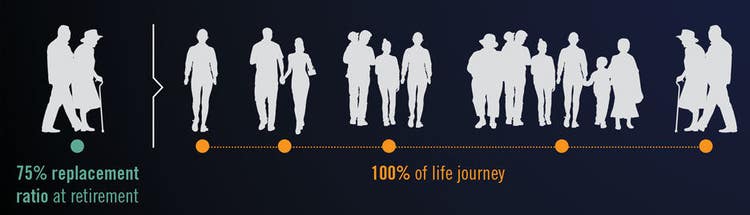
A six-year review
Notably, when we launched our new research publication in 2013, we didn’t call it Retirements Monitor or the Pension Fund Monitor, but rather, quite deliberately, Benefits Barometer. And, just as deliberately, we made sure that the discussion remained open about whose benefit we were addressing.
We needed to convey a message to employers, fiduciaries, policymakers and the industry that getting the right benefits to employees had a significant multiplier effect to the workplace, to society and to the broader economy. When Benefits Barometer was first released in 2013, the then Minister of Finance, Pravin Gordhan, echoed this clarion call when he made this point:
This is not an either/or choice. We need to broaden what we’re looking at as an industry and as employers (and what is needed from the government) and help solve for more things within the existing system while trying to influence aspects that aren’t working. We needed a narrative about the key environmental influencers:
- The impact and opportunities provided by the Fourth Industrial Revolution
- The need for jobs or entrepreneurship and promotion of small to medium-sized enterprises
- The recognition that a mindset of lifetime learning and skills development could go much further than ensuring that the educational system continue to perpetuate traditional outcomes
- An appreciation of how critical it would be to transform our economy from one of grant dependency to one of financial capability and fiscal responsibility – and all that this entails
This is the conversation that this publication has tried to have with its audience over these last six years.
What follows is a compilation of nine key insights that can be derived from the six editions of Benefits Barometer. Accompanying these insights are commentaries from five individuals, whose contributions as external observers helped shaped the narrative of Benefits Barometer over those years.